
Australia Skills Assessment: What Sri Lankan Professionals Need to Know Before They Apply
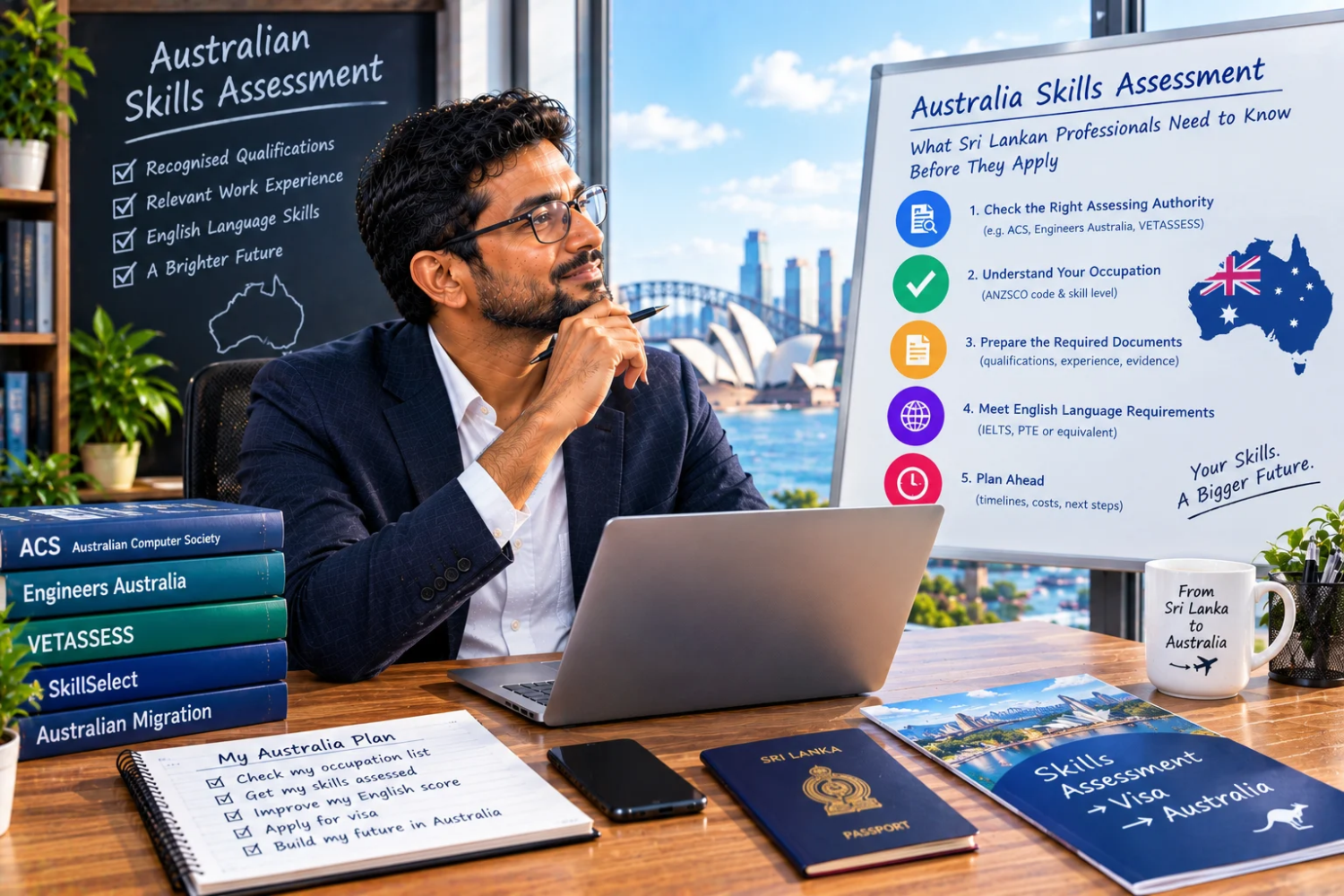
A civil engineer in Colombo, Sri Lanka, spends four months writing three career episodes. A friend offers to polish them for a fee. Engineers Australia’s own guidance says that having career episodes written by a third party counts as plagiarism. The penalty is immediate rejection and a ban of 12, 24 or 36 months.
An Australia skills assessment for Sri Lankan professionals is a document exercise. An assessing authority tests your qualifications and employment evidence against one occupation, and nobody interviews you to rescue a weak file. This guide shows which authority handles which occupation, what each one wants to see, and where a CV fits.
What an Australia Skills Assessment Means for Sri Lankan Professionals
A skills assessment is an independent check, by an approved assessing authority, that your qualifications and work history fit one specific occupation. For the points-tested skilled visas, you need a suitable outcome for the occupation you nominate, and the outcome must still be valid when you are invited to apply. Engineers Australia states that Home Affairs requires a valid outcome at the time of invitation.
The hard part is that every authority sets its own rules for the same kind of evidence. A document that one authority accepts, another rejects. And a failed file costs you more than the fee: you restart with a new application and a new wait. Engineers Australia gives you one 30-day window to fix gaps, so it asks for applications that are “assessment ready” on the day you submit.
This guide is general information. It does not tell you whether you qualify, whether your occupation is eligible, or which visa suits you. Confirm current rules on the Home Affairs website and your authority’s own pages, and speak to a registered Australian migration agent or lawyer about your case.
Which Authority Assesses Your Occupation?
The occupation code you nominate decides the authority, not your job title. Home Affairs lists the assessing authority next to each eligible occupation on its skilled occupation list.
In broad terms, VETASSESS handles many professional and managerial occupations, Engineers Australia handles engineering, the Australian Computer Society (ACS) handles ICT, and Trades Recognition Australia handles trades. Other bodies cover fields such as nursing, teaching and accounting.
Choose the occupation by reading its task description, not by matching your title. Engineers Australia tells applicants to pick the occupation that most closely matches what they do, based on the description and tasks in the classification. A title can mislead. The tasks cannot.
What Assessing Authorities Actually Look for in Your Documentation
Authorities check two things: that your qualification fits the occupation, and that your employment evidence proves skilled work in it.
On qualifications, each authority works differently. Engineers Australia runs accredited pathways for degrees from Washington Accord signatories and a Competency Demonstration Report pathway for everything else. Sri Lanka’s engineering accreditation body, the Institution of Engineers, Sri Lanka, belongs to the Washington Accord, but the accord only covers programmes that body has accredited, so check yours. ACS reviews the ICT content of your qualification and notes whether it is a major, a minor or insufficient.
On employment, the rules diverge:
ACS Employment episodes assessed for how closely they relate to the nominated occupation, underpinned by SFIAOnly professional ICT experience from age 18 counts.
| Authority | Employment evidence it describes | Rule worth knowing |
|---|---|---|
| VETASSESS | Reference letters, relieving letters, contracts, payslips, tax records and bank statements showing salary | It must be able to verify your evidence. Managerial occupations need an organisational chart. |
| Engineers Australia | A reference letter on letterhead with pay rate, hours, dates and at least five engineering duties, plus government-issued secondary records | Payslips, bank statements and statutory declarations are not accepted as secondary evidence. |
| ACS | Employment episodes assessed for how closely they relate to the nominated occupation, underpinned by SFIA | Only professional ICT experience from age 18 counts. |
Engineers Australia also counts experience only after you complete the qualification, and it defines employment as at least 20 hours a week. Its list of acceptable secondary records includes employee provident fund contributions, and a Sri Lankan EPF statement is the kind of record that category describes. But the assessor can specify acceptable documents for a particular country, so confirm before you rely on it.
The CV Format That Works for a Skills Assessment
A skills assessment CV is an evidence document, so detail beats brevity. Engineers Australia lists “your detailed CV” as a required document on every pathway, and other authorities commonly ask for one too. Check each authority’s checklist.
Build it around your reference letters:
- Dates and titles: Use month-and-year dates and the exact job titles your employers will confirm.
- Hours and type: State full-time or part-time and weekly hours for every role.
- Duties: Describe what you did in the vocabulary of the occupation you nominate, and claim nothing you did not do.
- Evidence: Add scale and outcomes with numbers, so an assessor can see skilled work, not only duties.
- Qualifications: List institution, dates, major and any professional registration or CPD.
My recommendation is three to four pages for a long career, because the assessor reads for proof, not polish. And every title, date and duty must match your reference letters and application forms. A mismatch makes an assessor ask which document is true.
Your CV is the only document in this process where professional writing help fits. The career episodes and summary statement that Engineers Australia requires must be your own words.
The Most Common Reasons Skills Assessment Applications Fail
No authority publishes rejection reasons by nationality, so I cannot give you a Sri Lanka-specific rate. The authorities’ own rules show where files break:
- The wrong occupation or authority. The file proves skills for an occupation the applicant did not nominate.
- Thin reference letters. Engineers Australia wants job title, pay rate, hours, dates, a signatory with contact details and at least five duties. A generic “to whom it may concern” letter falls short.
- Evidence the authority does not accept. Payslips and bank statements work for VETASSESS but not as Engineers Australia secondary evidence.
- Experience counted too early. Engineers Australia excludes experience before the qualification was completed, and ACS counts only professional ICT work from age 18.
- Third-party writing. Career episodes written by someone else bring rejection and a ban.
- Incomplete or misleading information. Engineers Australia says either one leads to an unsuccessful outcome, with sanctions.
(Nobody mentions this part until the rejection letter arrives.) If any of this describes your file, a discovery call is the fastest way to see what your CV has to carry.
Book here.
Getting the Assessment Right Before You Apply for the Visa
Work in this order:
- Pick the occupation first, using its task description.
- Confirm the authority on Home Affairs, then read that authority’s checklist for your occupation before you collect anything.
- Request reference letters early, written to the checklist, and build your CV from them.
- Check validity against your timeline. Engineers Australia notes that you can usually request an updated outcome letter once an outcome is more than three years old, and other authorities set their own limits.
Our Australia skilled migration guide covers how the points-tested visas fit around this step, and our Australia migration CV writing service handles the CV side.
Before you gather a single document, open the authority’s checklist for your occupation and tick it against what you hold today. Every gap you find is cheaper to fix now than after you lodge.
Frequently Asked Questions
Do I need a skills assessment for Australian skilled migration?
For the points-tested skilled visas, you need a suitable assessment for the occupation you nominate. Engineers Australia’s guidance adds that you need its outcome letter before you can apply for a visa. Check the Home Affairs page for your visa for the current rule.
Which authority will assess my occupation?
The occupation code you nominate decides it. Home Affairs lists the authority beside each occupation, and common ones include VETASSESS, Engineers Australia, ACS and Trades Recognition Australia.
Does Engineers Australia accept Sri Lankan engineering degrees?
Degrees accredited by the Institution of Engineers, Sri Lanka can use the Washington Accord pathway. A degree outside that accreditation uses the Competency Demonstration Report pathway, which requires three career episodes, a summary statement and a CPD statement.
Can someone write my career episodes for me?
No. Engineers Australia treats career episodes or a summary statement written by a third party as plagiarism. The consequence is immediate rejection and a 12, 24 or 36-month ban, and your details may go to Home Affairs.
Which employment documents do assessing authorities want?
It varies by authority. VETASSESS accepts reference letters, payslips, tax records and bank statements. Engineers Australia wants a detailed reference letter plus government-issued secondary records, and it does not accept payslips or bank statements as secondary evidence.
How long does a skills assessment outcome stay valid?
Validity differs by authority. Engineers Australia says Home Affairs requires a valid outcome at the time of invitation, and that you can usually request an updated letter once an outcome is more than three years old.
What if my application has gaps?
It depends on the authority. Engineers Australia allows one 30-day window to address identified gaps, and VETASSESS issues a letter stating you have not met the requirements if the occupation criteria go unmet. Submit a complete file first time.
Get an honest assessment of whether your CV supports the occupation you plan to nominate. Talk to us about your Australia-ready CV.
About the author:
I am the founder and chief consultant at ProDesignCV, based in Colombo, Sri Lanka. My clients have gone on to secure more than 500 skilled worker and migration visa approvals across the UK, Canada, Australia, New Zealand, Germany, the Netherlands, Singapore, and the USA, supported through CV and application document strategy. I also serve as chief system architect of an Applicant Tracking System built for the Australian, New Zealand, UK, and Canadian job markets.
References
- VETASSESS, Skilled Migration for Professionals FAQs https://www.vetassess.com.au/resources/faqs/skilled-migration-for-professionals
- Engineers Australia, Prepare your Migration Skills Assessment application (January 2026) https://www.engineersaustralia.org.au/sites/default/files/2026-02/Prepare-your-migration-skills-assessment-application-Jan-2026.pdf
- Australian Computer Society, ACS Migration Skills Assessment https://www.acs.org.au/msa/information-for-applicants.html
